This week UWE are running a short welcome session for doctoral candidates who are studying on one of the professional doctorate routes – the EdD. This programme has two major parts to it, the first being comprised of a structured taught element and the second is the supervised research phase. An overview of this professional doctorate can be found on the following UWE Course page.
We are also being quite innovative with this particular session because the presenters will be physically located at UWE, Bristol and the participants will be joining remotely using a video conferencing client called Visimeet.
The agenda for the day is contained in the presentation which I have embedded below.
From: Neil Willey, Director of the UWE Graduate School
It’s just over a year ago now that UWE set up its university-wide Graduate School and then celebrated the launch, so I thought it might be a good time to reflect on how things are going. Personally, I think we’ve now got a pretty sturdy one year old and that we’ve already mostly done teething and walking! I’m pretty acutely aware, however, that walking is just the start and that, let alone running, we probably need to be triple jumping or something fairly soon. There are two things that particularly struck me during the year and which make me think triple jumping might be possible…….
The first is the great team of people that were assembled into the UWE Graduate School. I’ve realised how many people at UWE already appreciate this, and really do wish that all the research students and supervisors at UWE have the opportunity that I do to engage with Graduate School staff – because I think they would then realise the interest and expertise available to them. I believe that the Graduate School can be really helpful to PGR students and supervisors across the university but that we all have to, somehow, be in sufficient contact with each other for this to really happen. During the first year this was exemplified to me in skills development events for students and supervisors. The development events that I was part of seemed to be of great benefit to everyone, which is making me think a great deal about how we can extend the experience to more students and supervisors.
The second thing that spurred me on to believe that the Graduate School at UWE can really go places is the real importance of PGR, both generally and to UWE. Contact with lots of students and supervisors from across the university over the course of a year really emphasises what fantastic things PGR students and their supervisors do. I’ve learned about so many things from across all the Faculties that could really make a difference to the world. To me it seems crucial that UWE has signalled its intent to have a healthy PGR community, but I do wonder if we all realise how central it can be to all that UWE wishes to be.
So, after a year I’m confident that we’ve made a good start and that the UWE Graduate School can really be helpful to PGR students and supervisors. Contact across the Faculties has given me quite a clear picture of the UWE PGR community and how the Graduate School can help. It has, however, started me thinking that perhaps the more channels of communication are available, the more difficult it is to communicate. It’s also been a reminder of the committee work necessary in a large institution! Overall, I’m happy that we’ve now got an overall focus for PGR at UWE that we can build on to respond to the needs of our research students and supervisors.
This week we ran a workshop entitled “The effective researcher- the middle years”. This is a workshop aimed at those who are midway through their doctoral degrees and are looking for reassurance and guidance about how to keep things on track. It is well known among PhDers that there is a period of difficulty – some will call it the second year slump, others give it the nom de plume of “The Valley of Shit” – where progress is hard to come by, perspective falls by the wayside where it’s easy to question why you thought it was a good idea to sign up to undertake a research degree. Most people I know who have finished a doctorate will tell you that this is part and parcel, goes with the territory and so on. But should it be and how to break out of the funk?
I set out in this workshop to discuss some strategies to aid researchers in navigating this difficult period, to allay some fears and offer the chance for folks to connect with each other. What was surprising about this workshop (and maybe the title had something to do with it?) was that all of the attendees were part time doctoral students.
Here’s the slides I used to support the session with acknowledgement to Dave Filopovic-Carter (Dave F-C to most of us!) who compiled most of the materials used.
One of the most pressing problems for doctoral students is understanding what the standard to be achieved is. One way of articulating this is to familiarise oneself with the Doctoral Descriptors. UWE has its own (derived directly from the QAA descriptors) which I’ve embedded below:
A further issue for doctoral students in the middle years is the feeling of disconnectedness, an inability to see how the various strands of an often messy research project fit together to make a coherent argument from an individual perspective; to make your thesis clear. This is quite neatly summarised in the work that Professor Gina Wisker presented at UWE on conceptual thresholds and learning leaps in doctoral study.
Doctoral students in the middle years also feel like they are not progressing, either intellectually or research outputs (or outcomes?). This is why I believe it is important for researchers to be given the time and space to reflect on how much they have developed since starting the journey. Participants who come to the UWE residential gradschools (which we run in Buckland Hall in the Brecon Beacons) report back how useful it was to reflect on just how much one develops throughout this process.
Vitae have developed a framework for researchers to map out their development that places a focus on the knowledge, behaviours, attributes and competencies that make for successful researchers. There’s more info on that framework below.
At the end of November my good friend and colleague Janet Wilkinson from Three Times Three helped me to deliver a session for the UWE Researchers’ Forum. The theme for the forum was “toward a research active lecturing post”, a topic that concerns lots of researchers and academics. On the one hand there are staff employed on contracts to undertake research only but would like to acquire more teaching experience for their professional and career development. On the other are some early career academics who are battling with hectic teaching schedules and would like to redress the balance by devoting more time to research, again to enhance their career development.
So I asked Janet to facilitate discussions between staff from these two groups to help illuminate what they would need to think about and act upon to achieve their goals. I then asked Janet to write about it, so with permission here are her thoughts on how to frame that discussion.
I’m the kind of person who regularly craves change – I chase new experiences, new learning in new destinations and the opportunity to meet interesting people in new surroundings. I’m really lucky that my working and home life accommodate this craving.
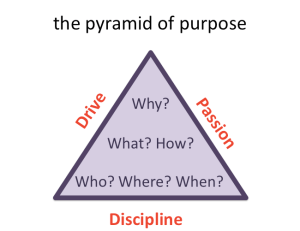
In 2012 I’ve noticed the emergence of a different craving – that of more stability and consolidation. How to blend both? Searching for a model to frame my future planning I’ve turned to books and blogs, friends and colleagues and a day spent at the Guardian TEDx in Bristol. My work in progress is an adaptation of the ‘pyramid of purpose’ that I’ve been working with, adapting for my own needs and sharing with others – most recently at the Researchers Forum at UWE.
Influenced by Paul Spencer’s recommendation of Simon Sinek’s TED talk and book I’ve been ‘Starting with Why?’. Why do I want this change? Why do I need this new experience? Why do I think I will find what I want in the direction I am proposing? It has been helpful to start here as sometimes the lack of an answer has stopped me chasing a change that was ultimately a superficial whim; similarly it has helped me to clarify why I really wanted the change in the first place. Drive and passion help you to get to where you want to go but are more gainfully employed when you understand why you want to go there in the first place.
Identifying why you want to do something or change something then facilitates the more practical questions of what constitutes that change and how you are going to bring it about. If ‘why?’ is the bigger picture the ‘what?’ and ‘how?’ start to dig into the detail to start to make the change. A big picture person by nature I’ve found that David Allen’s Getting Things Done book has helped me take larger tasks and goals and to consider them in more detail right from the start make them all into a project with the concept of next action fitting neatly with the questions –
What do I want to do?
What needs to happen next?
How am I going to bring that about?
How long will it take?
The ever more practical questions of Who? Where? And When? Start to put definite actions around my goals and plans and with a clear purpose help me to structure how I am going to bring this change or plan about and where I need to be flexible and include others in the plan.
I’m keen to think about the questions Who can help me? or who would I need to know better? I find it difficult to ask for help and yet know that I am always happy to help those who ask me. I don’t think I’m alone here.
I’ve added discipline to the pyramid of purpose as I’m fascinated by the success I see around me when discipline is added to drive and passion to bring about the change that people identify and focus on. My observation is that drive alone can be a powerful force but when combined with the discipline to return to the purpose, and the plan it generates, and to follow through on the actions you identify can bring about achievement for you (and those you lead) that sticks to an understanding of why you were doing it in the first place.
This is essentially a competition to communicate your research in an accessible way. It’s part of my life to encourgae researchers to do this, I’ve written about communication here and here. That’s why I’m glad that Jorge Cham is raising the bar and injecting a bit of fun into the process.
Focussing on why and taking the time to be creative without dumbing down are two key ingredients for engagement about the research we do.
The 2 minute thesis competition is now over and the winners and entries can all be found here:
Today I am running a short session with UWE colleagues who support researchers who are applying for research funding. There are three main reasons why I think this should be explored:-
Social media tools can really help with horizon scanning – keeping up to date with what funding calls are out there etc.
The ability to keep up with a professional network outside of conferences/meetings
To understand why researchers are increasingly using social media in the course of the work to better support their needs
We will be hanging around under the hashtag #druwe.
I’ve edited down a prezi that I have previously used with researchers themselves to provide the framework for today. The main points to cover are:-
Social media is radically changing the way we think about publishing information/sharing knowledge in perhaps the same way as the printing press revolutionised information distribution in the past
Lots of folks have concerns about putting things online w.r.t. a digital identity. Thinking about what other people can see about you is important, even to the point of being in control of your professional self online
Twitter is an obvious tool for many in terms of maintaining contact with a professional network, need to have an understanding of how to make it work for you
Linked to that is the idea of using filters to prevent being swamped with information – we will talk about portals and aggregators to help manage information streams
I will focus on why researchers are increasingly using social media tools to help them in their research activities, important to know for those who support researchers in their endeavours
Blogging. This for me is an interesting way of sharing knowledge within a network, keeping yourself engaged with the topics you’re interested in (professionally) and providing a much needed space to reflect on your work.
Some advice on an etiquette for the internet? How to avoid some pitfalls.
There are some other examples out there of research support staff who run either single author or multi author blogsites around the funding of research.
Research Fundermentals – A blog by Phil Ward, a research funding manager at the University of Kent. Well written commentary on topics relating to research funding professionals as well as the wider debates.
Bournemouth University Research Blog – A comprehensive repository of advice, links, information relating to research activity at Bournemouth University. One could say that this a complete solution to the conundrum of how do you have a joined up apporach to research support in a website.
Northumbria Research Support – Another comprehensive blog covering all aspects of research support at Northumbria University.
This is an interesting workshop that I ran at the beginning of the week; the title is more inclusive than its predecessor which would be something like “The Student-Supervisor Relationship”. Ostensibly what I set out to do was to help researchers (both students and staff) understand a little more about their preferred ways of working and to talk through some strategies that I’ve used to balance my own relationships in my working life (although I’m pretty sure that some of the following insights help with other avenues of life as well).
Disclaimer time:- I’m principally talking about the Myers Briggs Type Indicators (MBTI) here and I’m not a certified expert. I’m not a fanatic of personality typing and generally I steer well clear of schemes that classify folks into ‘types’ or those that make value judgments about competence based on typing.
Having said that, my experience of MBTI in the context of working relationships (particularly that between a research student and their supervisor) is a useful tool to help understand that other folks have different preferences when approaching certain things which can be infuriating if your preference is not at all similar. Just by understanding that these approaches are driven by our preferences instantly reduces that feeling of frustration because it makes you realise that it isn’t a conscious choice in the most part.
I used some slides to illustrate the dichotomies as described by MBTI, as opposed to administering the MBTI instrument, no pronouncements were made other than for me to reveal that I am an ISTP.
EDIT: If you want to find out more about your own preferences using this tool then the UWE Careers Service has a subscription to a type dynamics assessment . You will need to physically be on the UWE network to use it. If you are not from UWE, maybe your own Careers Service has a similar scheme? Why not ask and find out?
I think folks spend a lot of time thinking about the difference between an “Introvert” and an “Extravert” – there is an important difference in MBTI parlance from that of the everyday use of the terms. Put simply it is about where your focus is in terms of energy, I once heard it described as the difference between being battery-powered or solar-powered which I think is a neat way of putting it.
However it is described I can safely assert that I am very much an introvert. This is both wonderful and, at times, exhausting. I do have to spend lots of time interacting with people, standing up and talking, talking and more talking but I do love my reflection and recharging time.
The other area in which I demonstrate a pretty strong preference is in the dichotomy termed “Judging” vs “Perceiving”. I am strongly the latter. Some people earn the label “Mr Last Minute”, well I am the Captain of all last minutes; in fact as a PhD student I wrote up the bulk of my thesis in a matter of weeks because there was an immovable deadline. But here’s the rub, since I’ve become more aware of my preferences I now know that I can’t behave like that all the time, there are many situations where I have to resist my urge to wait/to gather more information/holding off on committing/it’s never too late to have another good idea- because I work with other people for whom that approach frightens and stresses them. I care about the state of health of my colleagues so inevitably I work at minimising the stress I cause others.
Another important element of working with others is the giving and receiving of feedback. In Academia, there is a notorious lack of sugar coating anything and quite often a lack of clarity about things to improve. So I spent time on how feedback should be done…
A couple of things to point out here. I used JoHari’s Window only to illustrate the conundrum around feedback. I’ve seen this model misused so many times where folks have been left feeling dysfunctional because of the misunderstanding around the “Blind Spot”. Basic concept here is to try and increase your public facade. This model demonstrates that in order to achieve that you have to do two things that make most people feel vulnerable:
Disclose more about yourself (decrease the amount that is private and hidden from others)
Seek feedback from others (decrease the amount that is unknown to you – blind to you)
Once this becomes clear, then JoHari’s window isn’t quite so scary and just becomes another of putting a vocabulary to ones own development.
But I think the best thing to take away from feedback is to realise the analogy of it being a a gift. Some gifts you receive from family are useful and some not so. You would always thank someone for giving you the gift even if you chose not to make use of that gift.
Last thing I touched on was about Eric Berne’s concept of transactional analysis as a way of explaining how sometyimes it’s easy to predict a reaction from others depending on how we approach it. If we communicate like a parent, this model suggests we should expect the receiver to react in the exact opposite state, i.e. to react like a child.
I can’t say that I’m really into these models but they do provide a way of engaging in a discussion about how we work and collaborate with others which is, after all, what I was trying to do…
It seems an awfully long time ago now that I was a postgraduate research student at UWE, I began my PhD in the late Autumn of 1997 eventually finshing some 4 (and a bit) years later. Back then I felt enormously proud to be a “postgrad”, being involved with assisting in laboratory sessions, running experiments, solving problems, supervising final year BSc research projects as well as working on my own research topic (oral malodour since you ask!). I was also acutely aware of some of the inequalities that many a research student faced in terms of feeling isolated, being somewhere between a valued member of staff and a student depending on the situation – generally a lack of distinct identity.
Which is probably why I ended up putting myself up for election as a ‘part time elected officer’ of the Students’ Union to represent postgraduate students (a fully non-paid activity). It was around that time (1999-2000) that I first heard of proposals to establish a Graduate School at UWE to help improve the doctoral experience. I was excited, the profile of postgrad research students would be raised, our contribution to the academic outputs of the institution would be recognised, our ills would be eased! In the end though, the university decided against an institutional model to support research students and opted for individual faculties (all 9 of them) to decide whether to set up their own Graduate Schools catering for both postgraduate taught and postgraduate research students, an outcome which did little to resolve the situation faced by the research students.
That was then, fast forward 10 years and several reorganisations of the university structures, we are now at 4 large faculties and a “One University Administration” (a process undertaken to disentangle the disparate administrative and professional support structures that have evolved over time like some sort of congealed spaghetti dish). The time was right to re-visit how we organised the support of postgraduate research studies at UWE, the proposals were set out, debated and decided upon and from January 2012 we now have a single Graduate School supporting postgraduate research students across the whole university.
I am excited again, having spent the last 8 years employed to support the skills development of research students, I know this move is a positive one; I also know that there is much left to do to make this model really work.
I’m not alone in showing enthusiasm for this, we have been lucky that we have retained a huge amount of experience in the Graduate School staff from the new Academic Director, Neil Willey to the adminstrators who have been supporting research students for years.
Here’s a video explaining why we established a Graduate School…
Sorting out the staffing structure is just the start, we need to get to grips with the information needs of both research students and their supervisors to help with the navigation of the research degree programmes on offer. This required a big rethink of the UWE website. Quite happy to report that we now have some dedicated pages to all things Graduate School related and a short URL to ease the remembering of it…!
The next task has been to raise awareness of the Graduate School so we decided upon a different sort of launch event, one that was more like a showcase of the different types of research that goes on here, one where discussions could be had over coffee and cake and one where you could put your feet up and take a load off.
Speaking of films, we also had two animated films produced for the event and website, “10 Reasons to do a doctorate” and “10 reasons to be a doctoral supervisor” both of which were animated by an alumni of the UWE MA in Animation, David Hutchinson. The films featured recorded voices of research students and supervisors from UWE talking about the best aspects of doctoral study.
The final part of the day was to screen the live action film from the Piled Higher and Deeper comic strip, an hour long film featuring research students and academics from CalTech. It was an amusing, ironic and perhaps touching look at some of the issues that many academics and research students face in academia. The trailer is here.
We are currently working towards having a physical location for all of the Graduate School Staff
There is space planned for Graduate School activities in the new Academic Hub that will be built in the medium term that will have space for research students to work & socialise
Currently working on more events for research students & supervisors
We’d like your thoughts on the direction we are taking, let’s make the Graduate School do what I’d hoped for back in 1999…
On Monday evening of this week, I put on an event for newly registered postgraduate research students at UWE, an event that had been postponed from October. It is something that we run every year to provide a space for new research students to get together from across the whole university. I think this is important because it introduces the idea that there are other researchers around who, whilst not being in the same discipline, are on a similar path.
We opened the event with an introduction from the Director of the UWE Graduate School, Neil Willey. His slides are here:-
Neil opened by highlighting one of the Doctoral Descriptors, the criteria for the award of a research degree, to explain that the goal, the end result is to come up with an original and significant contribution to knowledge. He pointed out that it was this that ultimately is the most satisfying, exciting, infuriating element of what most people refer to as a journey. He then went on to explain the place that the new UWE Graduate School will have in supporting postgraduate research students in that journey.
The main element of this gathering is that we invite current research students to pass on their thoughts about what it is like to be a research student to others. I only provided the title:- “What I know now, that I wish I’d known when I started” to the wonderful research students who volunteered to come and talk:- Anja Dalton, Billy Clayton, Amy Webber and Sarah Dean (take a bow folks!). The insights they gave astounded me because if I tried to write down all the hints & tips about being a research student that I could think of, I still wouldn’t have been able to cover everything that they did!
Here’s a flavour of the presentations with thanks to Billy, Amy & Anja who gave me permission to reproduce their work here:
I learned things from these presentations, the most common theme in describing a research degree is around a journey toward a summit and that there is a collective term for research students studying for a PhD; the PhDers!
Finally I summarised the PhD using the fabulous Illustrated Guide to a PhD by Matt Might which helps us all keep the magic of what we do into some sort of perspective.
 This week UWE are running a short welcome session for doctoral candidates who are studying on one of the professional doctorate routes – the EdD. This programme has two major parts to it, the first being comprised of a structured taught element and the second is the supervised research phase. An overview of this professional doctorate can be found on the following UWE Course page.




 The Digital Doctorate