From: Neil Willey, Director of the UWE Graduate School
It’s just over a year ago now that UWE set up its university-wide Graduate School and then celebrated the launch, so I thought it might be a good time to reflect on how things are going. Personally, I think we’ve now got a pretty sturdy one year old and that we’ve already mostly done teething and walking! I’m pretty acutely aware, however, that walking is just the start and that, let alone running, we probably need to be triple jumping or something fairly soon. There are two things that particularly struck me during the year and which make me think triple jumping might be possible…….
The first is the great team of people that were assembled into the UWE Graduate School. I’ve realised how many people at UWE already appreciate this, and really do wish that all the research students and supervisors at UWE have the opportunity that I do to engage with Graduate School staff – because I think they would then realise the interest and expertise available to them. I believe that the Graduate School can be really helpful to PGR students and supervisors across the university but that we all have to, somehow, be in sufficient contact with each other for this to really happen. During the first year this was exemplified to me in skills development events for students and supervisors. The development events that I was part of seemed to be of great benefit to everyone, which is making me think a great deal about how we can extend the experience to more students and supervisors.
The second thing that spurred me on to believe that the Graduate School at UWE can really go places is the real importance of PGR, both generally and to UWE. Contact with lots of students and supervisors from across the university over the course of a year really emphasises what fantastic things PGR students and their supervisors do. I’ve learned about so many things from across all the Faculties that could really make a difference to the world. To me it seems crucial that UWE has signalled its intent to have a healthy PGR community, but I do wonder if we all realise how central it can be to all that UWE wishes to be.
So, after a year I’m confident that we’ve made a good start and that the UWE Graduate School can really be helpful to PGR students and supervisors. Contact across the Faculties has given me quite a clear picture of the UWE PGR community and how the Graduate School can help. It has, however, started me thinking that perhaps the more channels of communication are available, the more difficult it is to communicate. It’s also been a reminder of the committee work necessary in a large institution! Overall, I’m happy that we’ve now got an overall focus for PGR at UWE that we can build on to respond to the needs of our research students and supervisors.
This course was designed to help researchers understand more about social innovation and social entrepreneurship. These are relatively new terms to describe the discovery or generation of new ideas that work to solve social and/or environmental challenges. It is important to raise awareness of social innovation because I believe that social innovation is probably the most important factor in meeting the economic and social challenges of the future.
However, for this particular course I decided to broaden the theme to social innovation because I believe that research is a pivotal strand of social innovation – researchers are fantastic at generating new ideas to tackle problems that society faces and are generally motivated by a desire to make a difference in society. I used the prezi below to set out my vision for the course.
One of the most inspiring people I have read about is Muhammad Yunus, a former academic who proposed and implemented a socially innovative solution to help poor women in Bangladesh start their own businesses. The following video takes up the story and gives an overview of social entrepreneurship…
The theme of the course is encapsulated by a quote from the playwright George Bernard Shaw
The reasonable man adapts himself to the world; the unreasonable one persists in trying to adapt the world to himself. Therefore, all progress depends on the unreasonable man.
I like this, it resonates strongly with my experience within academia, most researchers are passionate about what they do- they want to see their ideas make an impact in the world.
I decided to divide the course into themes covering motivations and values on day 1, creative problem solving and social impact on day 2 with the final day being about putting ideas into action. Here’s the programme that covers all that!
The thinking behind this theme for the day was to test the assertion that researchers are not motivated by fame and fortune; that there is a more altruistic driver behind this career choice. The following quotes sum up the day.
“People don’t buy what you do; people buy why you do it.” – Simon Sinek
“Think like a wise man but communicate in the language of the people” – W B Yeats
The first session focussed on communicating research in an authentic way. I like to use a model proposed by Simon Sinek, Start with why, because I think it works really well for the academic environment. I’ve written a fuller explanation here. The slides used in this session are below:
The afternoon session designed to explore the motivations and values of researchers, to think about what drives us to do what we do. Dr Lynn Clark facilitated this fascinating session and introduced a model that helps to focus on the positives; appreciative enquiry. The theme that resonated for me was her assertion that “diversity managed well leads to innovation”; here are her slides.
The first guest speaker for the programme was Andrew Thorp from MoJoyourbusiness who talked about the power of using stories to convey authenticity and purpose. What I liked about Andrew’s presentation is that he recapped many of the concepts explored earlier in the day with a slightly different perspective. His presentation is below…
I did film Andrew’s presentation but managed to overwrite the file (I had a rare technological disaster!). However, here is Andrew talking about similar themes in another interview.
Day 2 – Creative problem solving
This theme was reflect the changing nature of research, more research is inter disciplinary, more of our grand challenges require different perspectives and points of view to generate the kinds of sustainable solutions that are required. It is sometimes difficult to see this wider picture when immersed in the gritty details of our research. The following quotes sum up the day…
“If at first the idea is not absurd, then there is no hope for it.” – Albert Einstein
“The best way to have a good idea is to have lots of ideas.” – Linus Pauling
Day 2 started with a recap of the course so far and I showed two videos to join days 1 & 2 together. The first is by Steven Addis and was selected because of the nature of the story behind the pictures – how powerful it was that these were not just moments in time but a record of changing perspectives.
The second short video used was by Derek Sivers, for me it represented how easy it is for us to take our own perspectives of things for granted as being the way things are.
The first session of the day was introduced by Dr Chris Russell, from ThinkInspireCreate, to take the participants through a model of the creative process purportedly used by Walt Disney – Dreamer, Realist, Criticusing some of the current affairs on the news that day. This was a good warm up exercise for researchers, many of whom are much more comfortable taking the role of critically appraising others ideas, by using topics that were not necessarily anything to do with research.
This led to the main exercise of the morning, led by Dr Jim Boran, to generate some research proposals/questions around a grand challenge of an ageing population using a process called the Research Sandpit.This is an intensive process often used by the UK Research Councils to generate interdisciplinary research ideas that are funded in response to broad areas of interest.
Here’s a prezi that summarises the activity.
After lunch was to take the outputs generated from the morning activity to explore the potential impact and the resources needed to achieve that. This is absolutely vital in preparing research proposals for funders who will want applicants to map out “The pathways to impact“ of the work that they hope to undertake, they will want you to demonstrate that you have accounted for the necessary resources to deliver on the project. The impact of potential solutions are also critical to social innovation, no good having an idea if it doesn’t achieve any kind of change. The session was facilitated by Janet Wilkinson from ThreeTimesThree using a a moveable mind mapping tool called Ketso (itself a socially innovative idea from academia) to help participants to interrogate their plans, to pose the right sorts of questions to identify areas for further scrutiny.
The second invited speaker was Phil Tulba, a social entrepreneur, to talk through a number of key concepts that are important in achieving social change using Adrenaline Alley as an example. The prezi that Phil used is below.
And here is the video of Phil explaining all…
Day 3 – Putting ideas into action
The idea behind day 3 was to draw all of the concepts explored thus far and bring them together in an activity that was designed to raise awareness of a different way of doing business, social enterprise. It is often said of researchers that they are not aware of how business operates and/or they lack the commercial awareness to see their ideas implemented in wider society. I think this is disingenuous, I believe that most researchers are all too aware of how business operates, they are just not inspired by it so pay it little attention. The purpose of this exercise was to show researchers that not all business is counter productive to good research. The following quotes inspired the approach for the day.
“I have been impressed with the urgency of doing. Knowing is not enough; we must apply. Being willing is not enough; we must do.” – Leonardo Da Vinci
“The problem in my life and other people’s lives is not the absence of knowing what to do, but the absence of doing it.” – Peter Drucker
To recap and to point to the activities of the day I showed a short video about doing, “The Path of a Doer” from the Do Lectures.
The morning session was focussed on generating socially innovative ideas in different setting to that of research, to consider ideas that could feasibly be launched as sustainable ventures. The skills, competencies, attributes and behavious that we explored on the previous two days all come into play in this exercise by bringing like minded individuals together to develop an idea. It was facilitated by Dr Nathan Ryder, a freelance consultant in the field of researcher development.
As part of this exercise, a video was shown of some social entrepreneurs who explain more about social enterprise and how it can help to change things.
The slides for the presentation used in this session can be found below.
The last session of the day was designed to provide participants with an overview of the practical steps of taking an idea from a concept through to a full proposal, in other words how to make things happen. Dr Rick Watson from NovoModo and David Smith from InnovationWorks in partnership with the University of Manchester Innovation Group (UMI3) gave a quick tour of a toolkit they call the Social Enterprise Brief Case to assist academic researchers to take their ideas forward. Details of the scheme they are promoting were circulated via e-mail to the participants.
Further resources
A number of participants wanted some further links to the background information and books referred to that underpinned this course, here’s a list:-
One or two folks commented on the eclectic range of music that emanated from my laptop during the three days:- for those interested here’s an approximate playlist on spotify
The WordPress.com stats helper monkeys prepared a 2012 annual report for this blog.
Here’s an excerpt:
600 people reached the top of Mt. Everest in 2012. This blog got about 2,000 views in 2012. If every person who reached the top of Mt. Everest viewed this blog, it would have taken 3 years to get that many views.
This week myself and Janet Wilkinson are running a workshop specifically for part time students. There are two significant new elements to how we’re doing this; firstly the workshop will be be split over two consecutive evenings (in the past we have run this on a Saturday) and secondly we are going to have some of the participants join in remotely via videoconference.
In the first part of the workshop I will be focussing on two main topics:-
What is it like to pursue a doctorate on a part time (sometimes very part time!) basis, what are the challenges?
How can we manage and balance the myriad of things we have to do – any hints and tips on how to keep the thing rolling?
I have to admit I am in awe of part time doctoral students because they achieve truly astounding things. It also has to be remembered that the majority of PhD students do it part time. It is a ruinous fallacy to believe that the norm is full time and funded – it just isn’t the reality for many folks.
So time and finances are the immediate hurdles.
I’m going to be drawing on some Vitae resources today around the part time doctorate including using some videos of successful part time researchers.
It’s the first of these qualities that I want to delve into and is probably the reason why on the one hand that many PhDers fall by the wayside but on the other hand makes for a highly skilled individual on the other side. Pursuing a doctorate is not like any other type of study, the researcher has to be prepared to fail every day, to pick oneself up again and keep on going. It’s not like learning for an exam, it’s a long game of learning new stuff, imagining solutions to problems that noone else has thought about and then convincing others that you have actually come up with a solution.
The second thing I will delve into is tenacity in terms of time – the continual battle to put the hours into a demanding doctorate whilst keeping all the other plates spinning. I love the example of the professor who illustrated by using the example of the mayonnaise jar and two cups of coffee:-
‛A professor stood before his philosophy class with some items in front of him. When the class began, he wordlessly picked up a very large and empty mayonnaise jar and proceeded to fill it with golf balls.
He then asked the students if the jar was full. They agreed that it was.
The professor then picked up a box of pebbles and poured them into the jar. He shook the jar lightly. The pebbles rolled into the open areas between the golf balls.
He then asked the students again if the jar was full. They agreed it was.
The professor next picked up a box of sand and poured it into the jar. Of course, the sand filled up everything else.
He asked once more if the jar was full. The students responded with a unanimous ‛yes’.
The professor then produced two cups of coffee from under the table and poured the entire contents into the jar effectively filling the empty space between the sand. The students laughed.
‛Now,’ said the professor as the laughter subsided, ‛I want you to recognise that this jar represents your life. The golf balls are the important things – your family, your children, your health, your friends and your favourite passions – and if everything else was lost and only they remained, your life would still be full. The pebbles are the other things that matter like your job, your house and your car.
The sand is everything else – the small stuff. If you put the sand into the jar first, there is no room for the pebbles or the golf balls. The same goes for life. If you spend all your time and energy on the small stuff you will never have room for the things that are important to you.
Pay attention to the things that are critical to your happiness. Play with your children. Take time to get medical check-ups. Take your spouse out to dinner. Play another 18 holes. There will always be time to clean the house and fix the disposal. Take care of the golf balls first – the things that really matter. Set your priorities. The rest is just sand.
One of the students raised her hand and inquired what the coffee represented. The professor smiled. ‛I’m glad you asked. It just goes to show you that no matter how full your life may seem, there’s always room for a couple of cups of coffee with a friend.’
The last of the qualities that Matt Might talks about is cogency – the ability to communicate your research, to persuade others of its value. That’s the topic for the second workshop that Janet Wilkinson will lead.
Effective part time researcher Part 2
So, if you’ve read Paul’s blog post on the first part of the Effective Part-Time Researcher, you’ll see that he has created a ‘to be continued tomorrow’ opportunity for me to fill around the topic cogency in research.
I too am in awe of those who take on a PhD part-time. It is a major commitment in time, mental energy and flexibility. From the work I’ve done in the last nine years with part-time PhD researchers, and through supervision of part-time Masters students in their research and dissertation stage, I also see that there is strong requirement for making good choices. These are as varied as how you spend your time when you are in research mode, how you allocate time to your PhD and other major commitments in your life, the conferences and researcher environments you choose to be part of and also how you choose to work with your supervisors.
The second part of the Effective Part-Time Researcher programme focuses on how you find and develop your voice, how you use it to communicate with different audiences about your research and how you make use of and contribute to the supervisor relationship.
I am a maven for collecting techniques that others have found, used and recommended. I’ll share some of the top tips of others and take a practical focus around the subjects of:
Writing. How, when and what do you write?
Communicating your research to a variety of audiences
How can you get the best value out of Supervision?
Like Paul I will also draw upon a number of different resources during the session. The Handbook of Academic Writing by Rowena Murray and Sarah Moore will feature (and we’ll draw on Sarah’s YouTube video for a discussion about writing).
Being cogent and building relationships in our work is dependent upon good communication and this will be thrust of the workshop as will my overarching wrapper about having a strategy. Both are important so that you have a personal framework to make good choices about what you do and how you do it effectively within the time you have available to devote to your research.
This week we ran a workshop entitled “The effective researcher- the middle years”. This is a workshop aimed at those who are midway through their doctoral degrees and are looking for reassurance and guidance about how to keep things on track. It is well known among PhDers that there is a period of difficulty – some will call it the second year slump, others give it the nom de plume of “The Valley of Shit” – where progress is hard to come by, perspective falls by the wayside where it’s easy to question why you thought it was a good idea to sign up to undertake a research degree. Most people I know who have finished a doctorate will tell you that this is part and parcel, goes with the territory and so on. But should it be and how to break out of the funk?
I set out in this workshop to discuss some strategies to aid researchers in navigating this difficult period, to allay some fears and offer the chance for folks to connect with each other. What was surprising about this workshop (and maybe the title had something to do with it?) was that all of the attendees were part time doctoral students.
Here’s the slides I used to support the session with acknowledgement to Dave Filopovic-Carter (Dave F-C to most of us!) who compiled most of the materials used.
One of the most pressing problems for doctoral students is understanding what the standard to be achieved is. One way of articulating this is to familiarise oneself with the Doctoral Descriptors. UWE has its own (derived directly from the QAA descriptors) which I’ve embedded below:
A further issue for doctoral students in the middle years is the feeling of disconnectedness, an inability to see how the various strands of an often messy research project fit together to make a coherent argument from an individual perspective; to make your thesis clear. This is quite neatly summarised in the work that Professor Gina Wisker presented at UWE on conceptual thresholds and learning leaps in doctoral study.
Doctoral students in the middle years also feel like they are not progressing, either intellectually or research outputs (or outcomes?). This is why I believe it is important for researchers to be given the time and space to reflect on how much they have developed since starting the journey. Participants who come to the UWE residential gradschools (which we run in Buckland Hall in the Brecon Beacons) report back how useful it was to reflect on just how much one develops throughout this process.
Vitae have developed a framework for researchers to map out their development that places a focus on the knowledge, behaviours, attributes and competencies that make for successful researchers. There’s more info on that framework below.
At the end of November my good friend and colleague Janet Wilkinson from Three Times Three helped me to deliver a session for the UWE Researchers’ Forum. The theme for the forum was “toward a research active lecturing post”, a topic that concerns lots of researchers and academics. On the one hand there are staff employed on contracts to undertake research only but would like to acquire more teaching experience for their professional and career development. On the other are some early career academics who are battling with hectic teaching schedules and would like to redress the balance by devoting more time to research, again to enhance their career development.
So I asked Janet to facilitate discussions between staff from these two groups to help illuminate what they would need to think about and act upon to achieve their goals. I then asked Janet to write about it, so with permission here are her thoughts on how to frame that discussion.
I’m the kind of person who regularly craves change – I chase new experiences, new learning in new destinations and the opportunity to meet interesting people in new surroundings. I’m really lucky that my working and home life accommodate this craving.
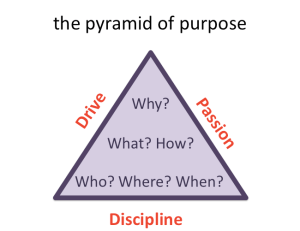
In 2012 I’ve noticed the emergence of a different craving – that of more stability and consolidation. How to blend both? Searching for a model to frame my future planning I’ve turned to books and blogs, friends and colleagues and a day spent at the Guardian TEDx in Bristol. My work in progress is an adaptation of the ‘pyramid of purpose’ that I’ve been working with, adapting for my own needs and sharing with others – most recently at the Researchers Forum at UWE.
Influenced by Paul Spencer’s recommendation of Simon Sinek’s TED talk and book I’ve been ‘Starting with Why?’. Why do I want this change? Why do I need this new experience? Why do I think I will find what I want in the direction I am proposing? It has been helpful to start here as sometimes the lack of an answer has stopped me chasing a change that was ultimately a superficial whim; similarly it has helped me to clarify why I really wanted the change in the first place. Drive and passion help you to get to where you want to go but are more gainfully employed when you understand why you want to go there in the first place.
Identifying why you want to do something or change something then facilitates the more practical questions of what constitutes that change and how you are going to bring it about. If ‘why?’ is the bigger picture the ‘what?’ and ‘how?’ start to dig into the detail to start to make the change. A big picture person by nature I’ve found that David Allen’s Getting Things Done book has helped me take larger tasks and goals and to consider them in more detail right from the start make them all into a project with the concept of next action fitting neatly with the questions –
What do I want to do?
What needs to happen next?
How am I going to bring that about?
How long will it take?
The ever more practical questions of Who? Where? And When? Start to put definite actions around my goals and plans and with a clear purpose help me to structure how I am going to bring this change or plan about and where I need to be flexible and include others in the plan.
I’m keen to think about the questions Who can help me? or who would I need to know better? I find it difficult to ask for help and yet know that I am always happy to help those who ask me. I don’t think I’m alone here.
I’ve added discipline to the pyramid of purpose as I’m fascinated by the success I see around me when discipline is added to drive and passion to bring about the change that people identify and focus on. My observation is that drive alone can be a powerful force but when combined with the discipline to return to the purpose, and the plan it generates, and to follow through on the actions you identify can bring about achievement for you (and those you lead) that sticks to an understanding of why you were doing it in the first place.
I’m interested in the digital literacy of folks like me for a couple of reasons:
1) It surely makes sense to better understand how researchers using digital tools in the context of research so that we are better able to support them
2) I believe that the very same digital tools can help staff supporting researchers to engage in their own professional development (something that we all want more of!)
The slides I used to support this workshop are below.
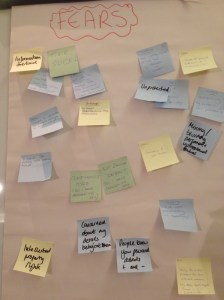
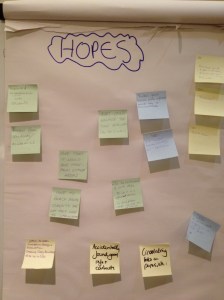
In this workshop we had a good number of conference attendees taking part, there was a mix of experience in the room which is what I had expected. One of the first things we asked people to do was to identify their hopes and fears about using digital tools. I predicted that the fears would fall into three broad categories:
Information overload – the fear that engaging in social media would be too much information to keep track of
Digital Identity – concern over what to share about oneself, privacy issues and the blurring of private versus professional
Data/intellectual property concerns – what happens if I share something that someone else exploits/stealing of ideas
Here’s what they said…
During the presentation I showed a couple of youtube videos to illustrate some points, the first was about the revolutionary effect of social media in general – the changing attitudes perhaps
The key points from this are:
Social media is not about technology or tools, it’s about people sharing things
We don’t have a choice about whether we do social media only how well we do it
The second video I used was Zella King talking about how social networks are important – researchers already know this but this video talks about how we can better understand how to makes networks work for us.
The key thing from this video to take is that one needs to understand who is in our network, both close ties and weak links which can be used for different purposes.
Remember that the use of the tools only make interacting with our networks a lot easier.
We used a lot of examples throughout the workshop about how researchers and researcher developers use tools at their disposal to make things easier. I talked a bit about what tools I use to compartmentalise my private versus professional life. I also talked about why I blog – I started a blog for myself, it was to reflect on the skills development events that I have run so that I can get it out of my head. It also serves as a repository of what I have done so I can refer back to it. A pleasing side effect of this is that others have found that useful and have begun to interact, comment and feedback which is fantastic for informing how to do things better – to improve ones professional practice!
I think we touched on something important for the attendees, many expressed an interest in using more digital technologies to improve on what they do which can only be good for all concerned.
Emma and I would be interested in knowing what you think about it, what hopes and fears do you have?
Around 18 months ago I started writing a blog on Posterous [http://ps-spencer.posterous.com/]. It was my way of keeping my thoughts about the researcher skills development workshops that I run out of my head, allowing me to focus on other things that were coming up. I really like the simplicity of the Posterous platform, it makes it easier to focus on writing something and sharing presentation materials. Yet, ever since Posterous was bought out by Twitter I have been looking over the fence at the other blogging platforms; partly because I fear that Posterous will disappear and partly because I think I am ready to experiment with a more comprehensive blogging platform.
So here we are, I’ve moved house to WordPress.com and, much like moving house in the real world, I have brought most of my stuff lock, stock & barrel over from the old place. I am settling in and I find myself re-arranging the furniture to suit the new pad.
I suppose this blog entry really is a note addressed to self. It’s been a while since you’ve written anything and this is not good. You must remind yourself to write about the following as soon as you can:
“How to win funds & influence people” – a workshop that I ran a few weeks back (before Easter) that serves as an introduction to applying for research funding.
reSEARCH Careers [insert link here when you’ve done it] – a regional event organised by the SW& Wales hub of Vitae that brought employers and researchers together.
It’s this last one that has kept me extremely busy of late, organising, editing, recording, did I mention organising….
Anyway, here’s some videos that show what I’ve been upto…
10 Reasons to do a doctorate
The animation was by an alumni of the UWE MA Animation course, David Hutchinson. I captured the views of the research students and did the audio editing/transcriptions.
We didn’t want to leave out the supervisors in this so here’s…
10 Reasons to be a doctoral supervisor
Again, animation by David Hutchinson and I chased down supervisors to capture their views. It was a bit of an ambush…!
and lastly, here’s another bit of video – this time some good ol’ fashioned straight talking about the new UWE Graduate School..
I’m still very busy because the launch event is on Tuesday and there is much left to do… but I promise (myself) that I will write the entries above.









 The Digital Doctorate