Digital Researcher #druwe

Social media on electronic displayThis week I ran a workshop at UWE on the use of social media in the context of research. This workshop is along similar lines to a workshop that I ran in February 2012 for researchers and a workshop at the Vitae Conference in September 2012 for researcher skills developers from across the country.

Some context then about this workshop; researchers are changing the way they use digital tools in the context of their research. There is lots of work going on as part of the wider JISC Developing Digital Literacies programme including work being carried out by Vitae to better understand the development needs of researchers.

I’m interested in the digital literacy of researchers for a couple of reasons:

1) It surely makes sense to better understand how researchers use digital tools in the context of research so that we are better able to support them

2) I believe that these digital tools are key to researchers building their own professional profile in an increasingly competitive academic research environment.

The slides I used to support this workshop are below.

Prezi for #druwe
Prezi for #druwe


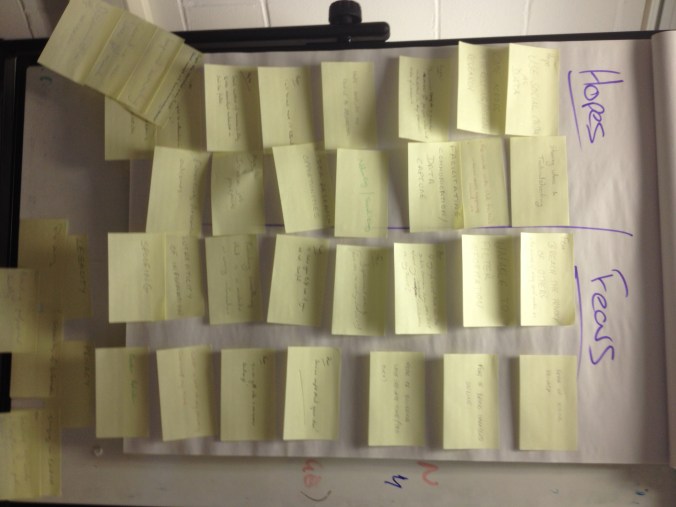
We started out the morning by highlighting some of the hopes & fears that researchers have about using social media tools… I predicted that the fears would fall into three broad categories:

  1. Information overload – the fear that engaging in social media would be too much information to keep track of
  2. Digital Identity – concern over what to share about oneself, privacy issues and the blurring of private versus professional
  3. Data/intellectual property concerns – what happens if I share something that someone else exploits/stealing of ideas
Hopes and fears

Hopes and fears

Hopes

Basic overview of what is out there

Getting research out there

To become more aware of others with similar interest & activities to my own

Catch up with colleagues who use twitter/blogs naturally

Which button do I press?

How to quantify opinion (or research data) gathered via social media tools

Fears

Maintaining privacy

Managing a digital reputation

How do I edit the digital me?

Will this become another distraction?

Digital Identity

We spent some time discussing online identity, how to balance the “personal me” vs the “professional me”, how different tools lend themselves to different purposes and how actively managing information about yourself is a good thing to do.

“We don’t have a choice on whether we do social media, the question is how well we do it”.Erik Qualman


Twitter

We asked the participants to use twitter to interact with their networks using the hashtag #druwe

https://twitter.com/UWEGradSchool/status/833993171273187328

Power of networks

We discussed a little bit of network theory, illustrated by this video for a TEDx talk by Zella King

Managing information overload

We had a look at portals and aggregators to help manage information streams.

Using social media tools in research

There is increasing concern about ensuring rigour when using digital tools to gather research data. At UWE, we have some guidance available on the Research Ethics pages. I think there is still some way to go to understand better how this area of social media use can be supported.

We discussed how research is social & iterative, the benefits of engaging with folks far and wide about your research outputs and how to use tools to make the finding out about knowledge a little easier. We had a play around with some social citation tools, e.g. CiteULike, Zotero & Mendeley

Blogs

We discussed why folks blog – a variety of reasons including:- organising thoughts, mind dump, getting feedback at an early stage etc.

This blog is a just one such example!

Netiquette

Summed up with “Common sense!”

Other sources of information

Here’s a list of things that I have come across recently on the topic of social media in research (clearly not exhaustive!):-

A blog about blogging in an academic research context from Imperial College – some really interesting advice and guidance here.

The Networked Researcher blog site which promotes the use of social media tools for researchers – “Digital Professionalism – what not to share”

The British Library – Help for Researchers – “Web 2.0 as a social science research tool”

The Guardian Higher Education site – discussing benefits of blogging as a researcher – “How blogging helped me find my research voice”

The Research Information Network site – “Social Media: A Guide for Researchers”

The Vitae/Open University “Social Media Handbook for researchers and supervisors”

Thanks to the researcher who attended both physically and virtually!

The Art & Science of Communication

This week UWE put on a two-day intensive course for researchers on the topic of communication. The intention behind this was to go beyond a regular ‘presentation skills’ course, more to have a nose under the bonnet of communication to examine the fundamental principles that could be used to craft a range of effective messages suited to the purpose at hand. Researchers find it challenging to find ways of engaging others in the research they do for fear of losing its academic rigour.

I brought in Piero Vitelli from Island 41 to shape the course into something of real substance that would be of value to the participants. Piero used the analogy of the course being a bit like Sachertorte, an incredibly rich and calorie packed chocolate cake to describe the deliberate attempt to put a lot of content into the two days.

Speaking of packing content or data into a short space of time, here’s a clip that should demonstrate that it doesn’t matter how complicated your data is, it is important to make it accessible.

Over the two days we set out to try and understand the secret behind impactful, engaging communication of research.

The following notes summarising the course are reproduced here with permission from Piero.


The basic model of communication we put forward was as follows:

comms model

More often than not, when we set about preparing a piece of communication we pay too little attention to the upper half of the pyramid, we focus on the content; the “what” of our communication.

We spent a lot of time looking at the “why” of our communication or in other words, what is behind our motivation to tell others about our research, what are our values, what do we stand for. I’ve written about this sort of thing before, it comes down to asking yourself “why”. This then informs “how” we might go about delivering the content.

Much of the rest of the course was about looking at the techniques and/or qualities of effective communication– getting into the mechanics of it all.

The other major talking point of the course was around the issue of confidence. Everyone talks about the need to feel more confident when giving presentations and most people assume that others have more confidence than they. It’s a weird thing but a presenter’s job is not to feel comfortable but to give every fibre of their being to the audience, to forget how uncomfortable it feels.

Only others can give confidence because it is, after all, about being “with trust” (latin:- Con fidere), so literally only others can have trust in you. You can see this demonstrated in this clip featuring Paul Simon playing a concert in Toronto when he invites a fan on stage (named Rayna) to play the song she requested (“Duncan”) because it was the one she learned to play guitar on… watch how Paul Simon has trust in her and provides the encouragement.

How ‘confidence’ really works?

Some last thoughts, I really enjoyed the stories, the metaphors and the analogies used by various folks throughout the two days. I was amazed by the risks that the participants took in trying things out to explain, illuminate, highlight or inspire about research to bring things to life. Here’s one picture that springs to mind: what you see (the number 6, the maths symbol sigma or the number 9) all depends on your perspective…

Is it a six, a nine or a sigma? - depends!

Is it a six, a nine or a sigma? – depends!

Further resources

The following publication is actually a piece of research about the art of presentations among public interest professionals. It is equally as relevant to academia and has some of the best advice contained within around “chunking”, taking audiences on a journey from A->B, considerations about the use of visual aids etc. And it’s free.

Why Bad Presentations Happen to Good Causes (free download)

Screen_shot_2012-02-23_at_12

A blog site about all things presentation related. It’s a must read…

Presentation Zen


Image Attribution

Sachertorte by _chris_st available from Flickr at http://flic.kr/p/by8tRy under a creative commons 2.0 licence. Full details http://creativecommons.org/licenses/by-nc/2.0/

The progression exam

Under the spotlight

Under the spotlight

This week I ran a workshop for our research students entitled “The Progression exam”. This is a formal milestone in the research degree journey that pretty much every doctoral candidate at any university will have to overcome. Some call it a “transfer” exam, others a “progression viva” but whatever the nomenclature they all have an aim similar to the following: –

a formal test of progress in the early stages to ensure a suitable basis for continuation on the programme has been established

I have run this workshop numerous times in the past and there have been one or two changes in how progression at UWE is now monitored.

Whenever I run a workshop on this topic or the related “Writing up” or “The Final Viva” workshops I always try to do two things:-

1) Provide knowledge about the process

2) Reduce anxiety by reassuring doctoral candidates

Recently at UWE we established a Graduate School at UWE with a new (and hopefully improved) web presence that puts all the information about research degrees in one place. We have created sections that relate to the major milestones including the progression exam.

Disclaimer: One should read my post in conjunction with the latest rules governing PG Research study.

Those rules are set out in section K of the UWE Academic Regulations here.

The slides that I used in the workshop are below:

Recent changes

From October 2013, all new research degree candidates will be subject to a slightly amended progression exam process where the option of re-submission (a time limited referral step) is now available to the examiners. Full details about this are on the  Graduate School website. Other recent changes are summarised below.

  1. When a progression report has been submitted, a viva will automatically follow
  2. Two independent examiners are appointed for a progression exam, one of whom will be designated the Principal Reviewer
  3. The Principal Reviewer may be used in subsequent progress review stages including the final viva voce examination if this is appropriate

Any queries about how the progression exam is arranged, the paperwork etc can be found by contacting the team in the Graduate School Office

Project Management in a Nutshell

It's a nutshell

Acorn in a nutshell

Last week I ran a 3 hour workshop for researchers entitled “Project Management in a Nutshell”. This is a variation of a workshop that I have delivered to a number of different audiences. The problem for me is that project management is littered with jargon that makes it seem very daunting to the uninitiated. Add to this you have very complicated-sounding schemes like PRINCE2 which just fuel the mystique!

The reality is that PRINCE2 is a methodology, a process-driven mechanism which does little to inform anyone of the basic principles of good project management, it’s a bit like trying to follow a recipe from a gourmet chef without any basic cooking skills. So my focus for this workshop was to de-mystify some of the language and to concentrate on the important fundamental elements.

The slides I used are embedded below.

Some basic hints and tips then:

  1. Know who your stakeholders are, what they want and how to manage them. Unless you meet their needs and expectations, the project won’t be successful.
  2. Define the scope and get it agreed up front. This sets the boundaries of the project, what you will do and (more importantly) what you will NOT do. The most common reason for projects to be late, over budget or below par on quality is because someone changes the scope part way through.
  3. Once you have a scope, you have to break down what needs to be done into small enough chunks so that it can be monitored – need to be thorough here, no room for being vague
  4. When all the tasks are worked out then it’s time to take stock and ask the question, what could possibly go wrong? In other words conduct a risk assessment on your project, how likely is it to go wrong and what impact will it have. If both likely to go wrong and completely de-rail things, then it’s time for a plan B!
  5. Having said that, it’s perfectly acceptable to entertain some risk in a project – without risk there is no innovation
  6. A plan is a plan, it is not a fixed thing but it helps you to keep on top of where things are. Important as the project manager to have the oversight, don’t let others change the plan without discussion.
  7. Plans can and do change, it is almost a certainty in research that things will deviate from the original course in some way or other but this means you have to be alive to when things aren’t going well at the earliest opportunity so you have the opportunity to do something about it before it gets too late or just darn stressful!
  8. The type of planning/monitoring tool is not really important as long as you have a robust method, it’s the principle that matters more.

So there’s a few snippets to be going on with, what are your experiences of managing projects? Do they fit the above principles?

To close the session I showed the participants this simple tale about getting things done… works well for the PhD process I think!

The final viva voce examination

Under the spotlight

Under the spotlight

As a follow on to the workshop on writing up the thesis, I ran a session on the final examination process for the research degree at UWE.

What I try to do with these sessions is two-fold:-

  1. Knowledge is power – much of the process is organised by others but if the doctoral candidate knows who is supposed to be doing what and when it makes it easier for them to keep things on track (i.e. nudge their supervisors..)
  2. Reduce anxiety – there is a lot of uncertainty around the viva, most people will never have had experience of an oral examination so I try and say as much as I can about how it will be conducted

The workshop slides I used are below and the first half sets out how it is done at UWE (it may be slightly different at other HEIs) with the second half being dominated with as much advice as I could muster about preparing for and surviving (!) the viva. More recently, a scholar who writes about the doctoral journey, Professor Gina Wisker, presented some of her work to research students in the Department of Arts. Some interesting observations about What Doctoral Examiners look for.

The basic hints and tips are these:-

  • know your field
  • know your thesis
  • be clear about your ‘significant contribution’
  • be enthusiastic!

A question that often comes up is “what questions will be asked?”. Unfortunately I don’t have the power of prediction and every viva is different, however the opening exchange will always be around giving you, the candidate, the opportunity to summarise your thesis. This is something you can prepare for by talking to people about your work as an overview, what’s the big idea, what excites you about it, what are the key things that have come out of it etc.

Again there are some great hints and tips out there to draw upon, here’s a few…

Some final thoughts:-

Although the viva is a hurdle to overcome, try to think of it as a golden opportunity to have a good natter about your research. It is unlikely that you will ever have this much attention from other scholars who are interested in your work! Many fruitful collaborations begin after a viva exam, it could take your research down a new avenue.

I also think it is important to try to stay cool (I know that’s easier said than done) and to ask for clarification on questions you don’t understand by saying things like “I’m not sure if I’ve understood, are you asking…?” Don’t be tempted to launch into an answer to a question that wasn’t asked!

If you are a UWE researcher, then have a look at the research degrees webpages and read the document that is given to independent chairs (at UWE we have an independent chair to facilitate the exam process to ensure that candidates are given fair treatment) as it sets out exactly how the examination will be conducted from a practical point of view.

Last words:- Be confident, you wrote the thesis and you know more about it than anyone else. So demonstrate confidence with authority, you’ve earned it!

Writing up a PhD – The final straight?

Hand typing at a keyboard

Tapping away

This week I ran a workshop for research students on the topic or writing up the thesis. I remember my own journey well and how exhausting it all seemed. I, probably like many other research students, did not relish the prospect of turning my research into a well crafted piece of writing so I procrastinated.. a lot! Much of my written work was completed in a matter of weeks right at the end only because I was given an immovable deadline, just what the doctor ordered for a classic last minute type of person.

I set out to try and help research students understand that it doesn’t (and probably never will) feel comfortable to approach such a seemingly daunting task as producing a thesis and I set about imparting as much wisdom, hints, and tips on writing as I could. This has led to this particular workshop being quite content heavy as it has been added to over the years (so any thoughts on streamlining the content will be appreciated!) incorporating bits and pieces from the Vitae Resources repository as well as nuggets collected from far and wide.

Two things I think are important about writing a thesis:-

  1. Writing should be thought of as being integral to the research, not as a add on activity
  2. The purpose of the written thesis is to convince the examiners that you meet the criteria for the award of doctorate – so clarity is important!

Here’s the slides.

Further resources

Throughout the session I made reference to a number of blog posts which I think are worth highlighting here:

The Thesis Whisperer – Edited by Dr Inger Mewburn; this is an excellent resource for folks navigating their way through a doctorate).


Patter – Professor Pat Thomson‘s blog – This has to be one of the best places to read up on the many challenges of academic writing.

There are some great hints and tips in the postgrad researcher section of the Vitae website on the topic of completing your doctorate that are well worth the time to read.
Finally, if you have any comments or advice about writing up then I’d love to hear them.

Research Data Management Best Practice

Under lock and key: keeping your data safe

Under lock and key: keeping your data safe

Last updated 12 November 2015

This week UWE put on a workshop on the topic of data management, something that is becoming much more important in contemporary research environments. Indeed JISC have been funding a number of projects on producing best practice in this area.

I was lucky enough to be able to invite the UWE research and knowledge exchange librarians,  Jenni Crossley to facilitate this session. We started out the session with a small quiz asking where the researchers were with their current practice of data management. The slides they used in the workshop are embedded below.

During the session, the researchers were asked to look through the template below to help them think about their data management plans.

There was also a short humourous take on data management…

The remainder of the session was used to explore the excellent resources that the the Library services have

Further resources

UWE guidance for researchers on data management

UWE guidance on secure storage of research data

Guide on Research Data Management from JISC

Informed Researcher booklet (need to register with Vitae)

Goodbye from Helen – and welcome back Paul!

Adieu

Adieu

As today is officially the last day of my secondment to the UWE Researcher Development Manager role, I just wanted to say goodbye and to thank everyone – not least Paul – for all your help, support (and patience!) over the last six months, and for making this such an amazing experience. Thankyou so much for your participation, enthuisasm and generosity in sharing your experiences with one another and me – it really has been a delight to work with you all, I’ve learned a lot, and wish you all the very best for the future wherever life takes you.

One of my final tasks was planning next year’s workshop schedule, which is now live on the UWE Research Events webpage: there are a couple of small changes to last year’s programme, so do please take a look and book your places. So Paul – over to you now ….

Helen

Getting to grips with your research career

Getting to grips with career

Getting to grips with career

Recently we held our twice-yearly UWE research staff development event, this time on the theme of “getting to grips with your research career.” As the title suggests the event was a space for researchers from across UWE to get together and reflect on where they’re at in their career, where they might want to go, and how to get there.

Since the University is about to review the researcher role grading process, it seemed opportune to get some’ feedback via a short questionnaire, about how researchers themselves perceive the step up from Associate to Fellow – both the difference between these roles, and the application process itself. Pam has kindly collated the feedback (see separate document) for you to look at.

We then heard from three senior researchers, who had been asked to offer advice as if to their younger, less experienced researcher selves. Richard, Glenn and Darren were all very generous and honest with their insights, and you can see their presentations via the UWE Research Support webpages.

After “Dear Less Experienced Self”, it was time for “Dear Future Me”: for this, the group used prompt cards articulated to the Vitae Researcher Development Framework, to identify a skill or attribute they could do to work on in order to help their career progression – and, because we like to keep things positive, two things they’re already good at and would like do even better.

To help make the RDF feel a bit more concrete and ‘lived’ (and get us up and moving a bit!), each small group stood in a circle and threw a ball to one another: the idea being that when you get the ball, you have to say what card/skill you chose, why, and how good you are at it already – with examples if possible!

While one usually goes away from these events with genuinely good intentions, life – in fact, just the sort of the things w talked about in part 1 – does have a habit of getting in the way. So, to try and keep the good intentions alive, everyone was invited to complete a ‘postcard to self’ listing up to 3 small, practical things to do in the next couple of months to help them move forward on the skills identified in part 2.

Many thanks to all – the presenters, Glenn and the rest of the Planning Group and, most of all, to everyone who came along on the day, for joining in with such enthusiasm – I do hope you found it a worthwhile and fun morning, and we look forward to seeing you again at the next (whole day) event on 1 December 2014.