Getting Published – strategies for successful researchers

Research journals on a shelf

Research journals on a shelf

This week UWE put on a workshop aimed at research students and staff on the topic of getting research published.

Setting the scene

We’ve run this particular workshop for the past 10 years in which time the landscape of scholarly publishing has changed (and is still). This time we invited a number of contributors to offer different perspectives on getting published. Richard Goodman, Leila Moore and Jo Billings from Taylor & Francis publishing group came along to give their perspectives as Managing Editors of a number of journal titles. Professor Andy Adamatzky and Professor Richard McClatchey, two experienced academics and journal editors gave their insights as academic researchers.

Challenging the publish or perish rhetoric

I also gave my perspective on this, being a former researcher who now supports the development of early career researchers and an advocate of open research.

Much of my presentation (below) was drawn from what Professor Pat Thomson has to say on writing for peer reviewed journals and the differences between that and writing a doctoral thesis. In particular I found elements of her book, co-authored with Barbara Kamler, Writing for Peer Reviewed Journals: Strategies for getting published really useful in framing this session.

Part of the research landscape is the obsession with metrics which many fear are driving the wrong sorts of behaviour in higher education. There are many people who share my unease about advice given to early career researchers – it goes along the lines of ‘find the highest status journal with the biggest impact factor in your field and publish there at all costs’. I think this doesn’t take into account of the changing face of scholarly publishing and makes it more difficult for researchers to start the process of getting their reputation out there. I believe that researchers need to disenthrall themselves with the idea that journal impact factors are a good indicator of research quality.

It can’t be ignored that a publication record is important in academia but I think the focus should come back to the purpose of scholarly writing and understanding who it is you are writing for. I talked about how difficult it can be to write for peer reviewed journals, it is hard because it requires a different approach to that of writing a thesis or writing an application for funding because the reader is different in all those cases. The context is the key thing here.


Here’s the slides I used on the day.

A publishers’ point of view

Richard Goodman then gave a publishers’ point of view on the publishing process giving an useful overview of the mechanics. There was recognition that the open access agenda is changing things and that publishers will have to adapt their practices to accommodate the shift. The slides he and his colleagues used are included here:

Many researchers fall at the first hurdle when submitting a manuscript to a journal simply by not understanding the scope and format that the journal accepts – reading and understanding the journal’s guidelines/instructions for authors is an essential step.

The changing landscape of scholarly publishing

Probably the easiest way (and my preferred way) of explaining the changing nature of research is through the medium of Piled Higher and Deeper Comics

It’s important to place scholarly publishing in the wider context of the drive to be more open and transparent with research – not just with removing barriers to the outputs of research but opening up the whole research process.

Funders of research in the UK have applied some pressure for this change by incorporating the requirements to be open into the conditions of funding but I think it is also worth pointing out that open research is good for the researcher themselves.

Using digital tools to boost your reputation

A key factor in the changing landscape is to use the tools at your disposal to promote your research, the outputs and indeed your interests as a researcher. There was some discussion about how you can do this (see the Taylor and Francis presentation) and I also run a further workshop on this entitled The Digital Researcher. The next one is in February.

Jorge Cham of PHDcomics helps explain the issue of communication.


Academics’ point of view on publishing

Richard McClatchey and Andy Adamatzky gave a short and valuable insight to how experienced academics approach publshing and indeed academic writing as part of their daily work. Their tips are summarised here.


Further resources and advice

1. Help and resources for authors from Taylor & Francis

2. Vitae Researcher Development Website on publishing your research (login required)

3. Why Open Research – new website for open researchers

4. JISC resources to help researchers with open access

5. Facilitate Open Science Training for European Researchers (FOSTER) – European-wide project supporting open research across Europe

First Steps to Small Group Teaching

Today teaching in front of classI ran a session for researchers entitled “First Steps to Small Group Teaching”. This is a workshop that hopes to serve as an introduction to the role of teaching assistant/demonstrator/seminar leader/stand-in lecturer. My first disclaimer is that I am not an expert in educational research and/or the politics of learning & teaching. What I do have though is 12 years experience of teaching in various guises, demonstrating, lecturing, training and facilitating – the latter have been my life for the last 10 years.

I set out to introduce some basic principles that I think are important to know. Mostly the participants in the session were either research students or early career research (only) staff who had some experience of teaching undergraduate and/or taught postgraduate students in one way or another. Some were keen to learn more about how to be a ‘better’ teacher with a view to securing an academic position.

I started out the session by gathering the experience of the folks attending and talking about the challenges that teaching presents. We also talked about what the opportunities might be from teaching, some clearly had an idea that it might be seen favourably if applying to be a member of academic staff with a mix of teaching and research – I did forewarn that the balance of teaching is heavy when more junior as more experienced academics seem to only want to offload their teaching to focus more on their research interests.

As it happens there was a relevant live chat about this topic on the Guardian Higher website . I believe there is an inherent problem in universities – academics are not generally rewarded with promotion for their success or otherwise in teaching – it is their research outputs that determine many things:- the papers, the grants won, the research students supervised etc etc that really count. Yet, there are those who continually perpetuate the idea that the more research intensive an institution, the better the quality of the teaching… something doesn’t quite add up there!

We also took a bit of a diversion into discussing Myers-Briggs Type Indicators (MBTI) and how awareness of ones own preferences might give us some food for thought about the relationship between student and teacher/lecturer and/or (perhaps more importantly) the relationship to ones own supervisors. UWE students and staff can access an MBTI test called “Profiling for Success” through the UWE Careers InfoHub.

There have been a few interesting articles about Introverts which (I personally have found) are somewhat controversial in their suggestion. This about Introverts in the academy is a case in point!

The main concern, I think, of many a researcher remains how to teach without looking the fool.

Here are the main themes of the day in the slides I used:

A couple of other resources to look at:-

I suppose the main points are these:

  • We all prefer to learn in different ways
  • There are lots of “theories” or models out there that try to describe that
  • Most of them are paper thin in terms of evidence
  • Students (especially undergraduates) tend to adopt strategies to learning
  • These strategies tend to override preferred styles (driven by motivation)
  • There is nothing inherently wrong with these strategies – perhaps we (as teachers) dislike “surface” learners the most though!

I’m a scientist by training so I don’t recognise the phrase “theory” as applied to the scenarios above, I found this site that explains my reticence and challenges the assumptions made in these models.

Learning Styles Don’t Matter

We talked a while about the use of visual aids, powerpoint as a tool that can be used and misused came up more than once and prompted me to show this video clip:

We also looked at a TED talk by Sir Ken Robinson, partly because of the perspectives he brings about education and partly it was a chance to see an engaging presentation style that uses humour, anecdote, poetry, insight yet no powerpoint….

His earlier TED talk from 2006 is just as engaging and personally relevant to me as a parent but as he says, aren’t we all interested in education?

I then moved on to talk more about the difference between teaching and being a trainer, facilitator and coach. The main difference for me is the latter require less telling but more asking and listening to the group. We spent a lot of time talking about “crowd control”, i.e. how do you manage a group of people in a learning environment. It brought back memories I had of the NUS run program “Training the Trainer” that was part of the National Student Learning Programme (NSLP) on which I both learned how to be a trainer and subsequently contributed to as a tutor. Within that program was a session entitled “Dealing with nightmare trainees” – somes tips to deal with disruptive/disengaged folks that we all come across from time to time.

We ended up by having just one more look at a TED talk, this time by Benjamin Zander. This is one of my favourite talks because it represents why enthusiasm and passion for what you do is so important to being able to enthrall others or to get them to think, do or feel something different as a result of your input as a teacher/trainer/facilitator. That, I think, is what we should be aiming for…

Digital Researcher #druwe

Social media on electronic displayThis week I ran a workshop at UWE on the use of social media in the context of research. This workshop is along similar lines to a workshop that I ran in February 2012 for researchers and a workshop at the Vitae Conference in September 2012 for researcher skills developers from across the country.

Some context then about this workshop; researchers are changing the way they use digital tools in the context of their research. There is lots of work going on as part of the wider JISC Developing Digital Literacies programme including work being carried out by Vitae to better understand the development needs of researchers.

I’m interested in the digital literacy of researchers for a couple of reasons:

1) It surely makes sense to better understand how researchers use digital tools in the context of research so that we are better able to support them

2) I believe that these digital tools are key to researchers building their own professional profile in an increasingly competitive academic research environment.

The slides I used to support this workshop are below.

Prezi for #druwe

Prezi for #druwe


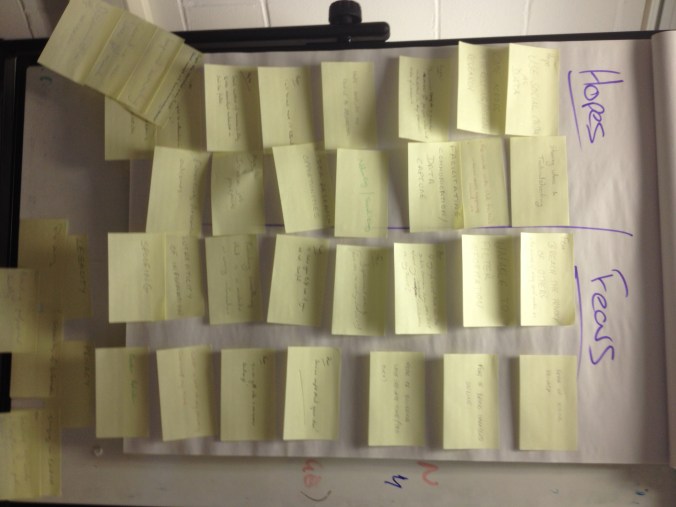
We started out the morning by highlighting some of the hopes & fears that researchers have about using social media tools… I predicted that the fears would fall into three broad categories:

  1. Information overload – the fear that engaging in social media would be too much information to keep track of
  2. Digital Identity – concern over what to share about oneself, privacy issues and the blurring of private versus professional
  3. Data/intellectual property concerns – what happens if I share something that someone else exploits/stealing of ideas
Hopes and fears

Hopes and fears

Hopes

Basic overview of what is out there

Getting research out there

To become more aware of others with similar interest & activities to my own

Catch up with colleagues who use twitter/blogs naturally

Which button do I press?

How to quantify opinion (or research data) gathered via social media tools

Fears

Maintaining privacy

Managing a digital reputation

How do I edit the digital me?

Will this become another distraction?

Digital Identity

We spent some time discussing online identity, how to balance the “personal me” vs the “professional me”, how different tools lend themselves to different purposes and how actively managing information about yourself is a good thing to do.

“We don’t have a choice on whether we do social media, the question is how well we do it”.Erik Qualman


Twitter

We asked the participants to use twitter to interact with their networks using the hashtag #druwe

https://twitter.com/UWEGradSchool/status/833993171273187328

Power of networks

We discussed a little bit of network theory, illustrated by this video for a TEDx talk by Zella King

Managing information overload

We had a look at portals and aggregators to help manage information streams.

Using social media tools in research

There is increasing concern about ensuring rigour when using digital tools to gather research data. At UWE, we have some guidance available on the Research Ethics pages. I think there is still some way to go to understand better how this area of social media use can be supported.

We discussed how research is social & iterative, the benefits of engaging with folks far and wide about your research outputs and how to use tools to make the finding out about knowledge a little easier. We had a play around with some social citation tools, e.g. CiteULike, Zotero & Mendeley

Blogs

We discussed why folks blog – a variety of reasons including:- organising thoughts, mind dump, getting feedback at an early stage etc.

This blog is a just one such example!

Netiquette

Summed up with “Common sense!”

Other sources of information

Here’s a list of things that I have come across recently on the topic of social media in research (clearly not exhaustive!):-

A blog about blogging in an academic research context from Imperial College – some really interesting advice and guidance here.

The Networked Researcher blog site which promotes the use of social media tools for researchers – “Digital Professionalism – what not to share”

The British Library – Help for Researchers – “Web 2.0 as a social science research tool”

The Guardian Higher Education site – discussing benefits of blogging as a researcher – “How blogging helped me find my research voice”

The Research Information Network site – “Social Media: A Guide for Researchers”

The Vitae/Open University “Social Media Handbook for researchers and supervisors”

Thanks to the researcher who attended both physically and virtually!

The Art & Science of Communication

This week UWE put on a two-day intensive course for researchers on the topic of communication. The intention behind this was to go beyond a regular ‘presentation skills’ course, more to have a nose under the bonnet of communication to examine the fundamental principles that could be used to craft a range of effective messages suited to the purpose at hand. Researchers find it challenging to find ways of engaging others in the research they do for fear of losing its academic rigour.

I brought in Piero Vitelli from Island 41 to shape the course into something of real substance that would be of value to the participants. Piero used the analogy of the course being a bit like Sachertorte, an incredibly rich and calorie packed chocolate cake to describe the deliberate attempt to put a lot of content into the two days.

Speaking of packing content or data into a short space of time, here’s a clip that should demonstrate that it doesn’t matter how complicated your data is, it is important to make it accessible.

Over the two days we set out to try and understand the secret behind impactful, engaging communication of research.

The following notes summarising the course are reproduced here with permission from Piero.


The basic model of communication we put forward was as follows:

comms model

More often than not, when we set about preparing a piece of communication we pay too little attention to the upper half of the pyramid, we focus on the content; the “what” of our communication.

We spent a lot of time looking at the “why” of our communication or in other words, what is behind our motivation to tell others about our research, what are our values, what do we stand for. I’ve written about this sort of thing before, it comes down to asking yourself “why”. This then informs “how” we might go about delivering the content.

Much of the rest of the course was about looking at the techniques and/or qualities of effective communication– getting into the mechanics of it all.

The other major talking point of the course was around the issue of confidence. Everyone talks about the need to feel more confident when giving presentations and most people assume that others have more confidence than they. It’s a weird thing but a presenter’s job is not to feel comfortable but to give every fibre of their being to the audience, to forget how uncomfortable it feels.

Only others can give confidence because it is, after all, about being “with trust” (latin:- Con fidere), so literally only others can have trust in you. You can see this demonstrated in this clip featuring Paul Simon playing a concert in Toronto when he invites a fan on stage (named Rayna) to play the song she requested (“Duncan”) because it was the one she learned to play guitar on… watch how Paul Simon has trust in her and provides the encouragement.

How ‘confidence’ really works?

Some last thoughts, I really enjoyed the stories, the metaphors and the analogies used by various folks throughout the two days. I was amazed by the risks that the participants took in trying things out to explain, illuminate, highlight or inspire about research to bring things to life. Here’s one picture that springs to mind: what you see (the number 6, the maths symbol sigma or the number 9) all depends on your perspective…

Is it a six, a nine or a sigma? - depends!

Is it a six, a nine or a sigma? – depends!

Further resources

The following publication is actually a piece of research about the art of presentations among public interest professionals. It is equally as relevant to academia and has some of the best advice contained within around “chunking”, taking audiences on a journey from A->B, considerations about the use of visual aids etc. And it’s free.

Why Bad Presentations Happen to Good Causes (free download)

Screen_shot_2012-02-23_at_12

A blog site about all things presentation related. It’s a must read…

Presentation Zen


Image Attribution

Sachertorte by _chris_st available from Flickr at http://flic.kr/p/by8tRy under a creative commons 2.0 licence. Full details http://creativecommons.org/licenses/by-nc/2.0/

The progression exam

Under the spotlight

Under the spotlight

This week I ran a workshop for our research students entitled “The Progression exam”. This is a formal milestone in the research degree journey that pretty much every doctoral candidate at any university will have to overcome. Some call it a “transfer” exam, others a “progression viva” but whatever the nomenclature they all have an aim similar to the following: –

a formal test of progress in the early stages to ensure a suitable basis for continuation on the programme has been established

I have run this workshop numerous times in the past and there have been one or two changes in how progression at UWE is now monitored.

Whenever I run a workshop on this topic or the related “Writing up” or “The Final Viva” workshops I always try to do two things:-

1) Provide knowledge about the process

2) Reduce anxiety by reassuring doctoral candidates

Recently at UWE we established a Graduate School at UWE with a new (and hopefully improved) web presence that puts all the information about research degrees in one place. We have created sections that relate to the major milestones including the progression exam.

Disclaimer: One should read my post in conjunction with the latest rules governing PG Research study.

Those rules are set out in section K of the UWE Academic Regulations here.

The slides that I used in the workshop are below:

Recent changes

From October 2013, all new research degree candidates will be subject to a slightly amended progression exam process where the option of re-submission (a time limited referral step) is now available to the examiners. Full details about this are on the  Graduate School website. Other recent changes are summarised below.

  1. When a progression report has been submitted, a viva will automatically follow
  2. Two independent examiners are appointed for a progression exam, one of whom will be designated the Principal Reviewer
  3. The Principal Reviewer may be used in subsequent progress review stages including the final viva voce examination if this is appropriate

Any queries about how the progression exam is arranged, the paperwork etc can be found by contacting the team in the Graduate School Office